Bad Ball Joint Symptoms: What You’ll Notice, What It Often Means, and What to Do Next

Quick Answer

Bad ball joints most often show up as clunking/squeaking over bumps or during turns, wandering or loose steering, and uneven tire wear or vibration—and because they affect steering and suspension control, any suspected looseness should be inspected promptly.

  • Noise + steering feel matters: A clunk/knock on bumps or turns plus vague steering is a common “inspect soon” combo. [S4][S5]
  • Boot damage is a red flag: A torn or leaking rubber boot can let grease out and contamination in, which can accelerate wear. [S6][S1]
  • Confirmation is vehicle‑specific: Inspection programs and manufacturers describe specific lifting and checking methods; some warn that the wrong test can misdiagnose or even damage the joint/boot. [S1][S7]
For car owners & fleets

Reviewed by: Steven (Founder & Head of Product & Market Strategy, JCM Auto Parts Co., Ltd., 15+ yrs)

Written by: JCMSTECH Research Team

Methods: teardown & inspection → cross-check supplier docs → fact-checking → scheduled updates

Last updated: 2026-03-05 · see revision log

Key takeaways

Use the tables below to connect what you notice → what it can indicate → the safest next step. Ball joints share symptoms with other front-end parts (tie rod ends, control arm bushings, wheel bearings), so treat this as a practical screening tool—not a final diagnosis. [S4][S1]

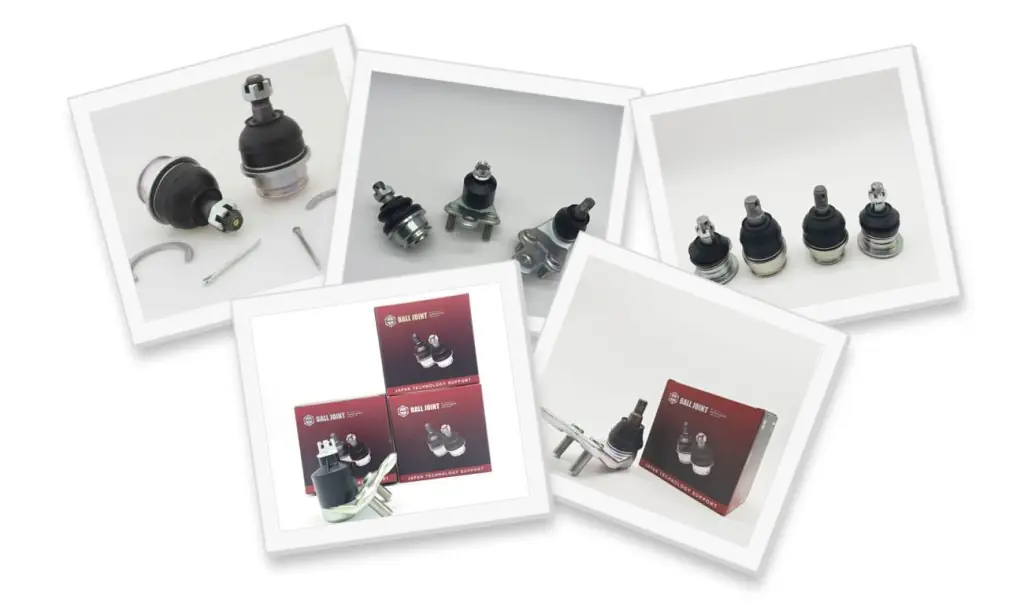
Close-up photos showing ball joints installed in front suspension assemblies, including the joint where the control arm meets the steering knuckle.
Ball joints sit at the control arm–to–knuckle connection. Play here can show up as noise, steering wander, or uneven tire wear.

Symptom → likely direction → what to do

What you notice What it can indicate (common patterns) What to do next Urgency
Clunk/knock over bumps or while turning Excess clearance in a jointed component (ball joint or tie rod end), or movement in a control arm bushing. [S5] Record when it happens (bumps, braking, turns). Ask a shop to check ball joint play and related steering joints. [S1] High if it’s loud, frequent, or getting worse
Squeak/creak from one corner Dry or contaminated joint, deteriorated dust boot, or bushing friction (often temperature-dependent). [S1][S6] Inspect for torn boots/grease leakage. If boot is damaged or missing, plan inspection/replacement. [S1] Medium–High
Wandering / loose steering / needs constant correction Front-end looseness can make steering feel sloppy; ball joint wear is one possible source. [S4] Reduce aggressive driving. Ask for a front-end inspection (ball joints + tie rods + alignment angles). [S4] High
Vibration or shimmy through steering wheel Loose/worn components can contribute to shimmy; balance and wheel bearings can also be involved. [S4][S1] Rule out tire balance first if vibration is speed-specific; have suspension/steering checked for play. [S4] Medium
Uneven tire wear (inner or outer edge) Geometry changes from looseness can accelerate edge wear; alignment and bushings can also be causes. [S4] Take photos of tread wear. Schedule an inspection and alignment check after any repair. [S4] Medium
Visible torn boot or fresh grease around the joint Boot damage can allow grease loss and contamination; some recall/inspection docs describe premature wear and potential separation if operated continuously in that condition. [S6] Prioritize inspection soon. Ask the shop to check the joint and nearby components for play. [S6] High

Tip: If you’re unsure whether the noise is “front-end” or “driveline,” a short audio/video clip captured safely can help your shop reproduce the condition.

“What does it sound like?” quick cheat sheet

Sound/feel When it often happens Common components that can create it How to narrow it down (safe)
Clunk / knock Bumps, braking transitions, slow turns Ball joint, tie rod end, control arm bushing, sway bar link Note whether it’s one side only and whether it changes with steering angle. Ask for a play check. [S1][S5]
Squeak / creak Cold starts, slow steering input, speed bumps Booted joint with lost lubrication, bushing friction Look for torn boots or grease on the knuckle/control arm area. [S1]
Clicking while turning Tight turns under power Often CV joint rather than ball joint (depends on vehicle) Have the shop confirm source—don’t replace parts by sound alone. [S5]
Humming/roaring that rises with speed Steady-speed driving Wheel bearing (more common), tire noise Compare left vs right on gentle lane changes; confirm with bearing inspection. [S1]
Replacement ball joint parts and packaging arranged on a white background, showing different ball joint sizes and shapes.
Replacement parts vary by vehicle: some ball joints press into the control arm; others are integrated into a control arm assembly.

Repair decision table (for owners and fleets)

Situation Common repair path What to confirm before buying parts
Ball joint is replaceable as a separate part Replace ball joint + inspect other joints/bushings; alignment check afterward is common practice. Upper vs lower, left vs right, taper/stud dimensions, boot/grease type, hardware included.
Ball joint is integrated into the control arm Replace control arm assembly (joint + bushings together); alignment check afterward is common practice. Arm style/material, bushing type, mounting points, and whether the joint is pre-installed.
Noise exists but play is not confirmed Diagnose systematically: steering joints, sway bar links, strut mounts, wheel bearings. Ask the shop for a play check method that matches your suspension design. [S1][S7]

Buyer’s checklist (helps avoid wrong-buys)

Info to provide Why it matters Common wrong-buys to avoid
Year / Make / Model / Trim (or VIN) Ball joints can change by trim, engine, and market. Buying “fits all trims” parts that don’t match the knuckle taper.
Front vs rear, upper vs lower, left vs right Upper/lower joints can be different designs and load directions. Ordering the wrong position (upper when you need lower).
2WD vs 4WD / suspension type Different control arms/knuckles can use different joints. Mixing 2WD parts on a 4WD knuckle (or vice versa).
Separate ball joint vs control arm assembly Some vehicles don’t service the joint separately. Buying a press-in joint when the arm comes as an assembly.
Greaseable vs sealed; boot orientation Service approach and clearance can differ. Grease fitting interference with wheel or knuckle.

Questions to ask your shop

  • Is the ball joint replaceable by itself on my vehicle, or is it part of the control arm assembly?
  • How are you checking for play (and does the method match my suspension type)? [S1][S7]
  • Did you see boot damage or grease leakage around the joint? [S6]
  • Which other parts did you check for similar symptoms (tie rods, bushings, wheel bearings)?
  • After the repair, do I need an alignment check (and why)?
What this guide covers

  • The most common symptoms drivers notice (noise, steering feel, vibration, tire wear).
  • How ball joint symptoms can overlap with other front-end components (and how to narrow it down safely).
  • What to document before visiting a shop and what questions to ask.
  • A buyer’s checklist to help match the correct ball joint or control arm assembly.

What it doesn’t cover

  • Vehicle-specific torque specs, press-fit procedures, or step-by-step replacement for every suspension design.
  • Pricing in your exact region (labor rates and parts choices vary widely).
  • Precise “maximum play” numbers for all vehicles—manufacturers and inspection programs can differ by model. [S1][S7]

If you need those details: use the related guides below (DIY steps, part selection, and sourcing).

Methods & Review

How this page was built

  • Reference baseline: official inspection guidance and manufacturer documents to ground safety-related statements and checking methods. [S1][S6][S7]
  • Symptom mapping: cross-checked common symptom descriptions against component-maker guides (noise, steering feel, tire wear). [S4][S5]
  • Procurement layer: compiled common wrong-buys and fitment questions from suspension category sourcing and after-sales feedback (year/trim, upper/lower, 2WD/4WD, integrated arm assemblies).

Limits

  • Symptoms overlap between multiple components; confirmation requires a proper inspection.
  • Maximum allowable play and the correct checking method can be vehicle-specific and can vary by inspection program. [S1][S7]
  • This page does not claim to replace a professional diagnosis.

Last updated: 2026-03-05 · Reviewed by: Steven (Founder & Head of Product & Market Strategy, JCM Auto Parts Co., Ltd.)

Sources

Tier-1 (agencies / OEM documents / standards)

  1. [S1] Driver and Vehicle Standards Agency (UK). MOT inspection manual: Axles, wheels, tyres and suspension (inspection methods; suspension joint dust cover and wear/play categories).
  2. [S6] Toyota (via NHTSA PDF). Camry front suspension lower ball joint Q&A describing boot damage → grease loss → premature wear/looseness and potential separation; notes that warnings may not appear.
  3. [S7] Daimler AG (via NHTSA PDF). “Ball joint check on front axle” bulletin: warns that some play checks are not required/possible; cautions against pry-bar testing; emphasizes boot condition and agreed test steps.
  4. [S2] SAE International. SAE J490 Ball Joints (scope and general/dimensional data standard listing).

Tier-2 (component-maker technical guides)

  1. [S4] MOOG Parts. Symptoms of bad ball joints (steering feel, vibration/shimmy, and uneven tire wear patterns).
  2. [S5] MOOG Suspension Parts. How to check ball joints (symptom descriptions; emphasizes technique and cautions).

Tier-3 (community / anecdotal)

Not used to support core safety conclusions on this page.

FAQ

Is it dangerous to drive with bad ball joints?

It can be. Ball joints are part of the steering and suspension linkage; looseness can reduce steering precision and stability. Inspection guides classify excessive wear/play in suspension joints as serious defects, and some OEM recall/inspection documents describe scenarios where a worn lower ball joint can separate from the knuckle if the vehicle continues to operate in that condition. [S1][S6]

If you’re hearing loud clunks, feel wandering/loose steering, or you can see boot damage/grease leakage, treat it as a priority inspection item and avoid hard braking, potholes, and high speeds until checked. [S6]

What happens when a ball joint fails?

In severe cases, the joint can become so loose that it no longer holds the suspension/knuckle relationship correctly, which can affect directional stability. Some OEM recall documents describe that a worn lower ball joint can separate from the knuckle if the vehicle is continuously operated after boot damage and premature wear. [S6]

Most failures are preceded by increasing looseness or symptoms, but not always—one Toyota recall Q&A explicitly notes there may be no warnings in the affected condition. That’s why visible boot damage or suspected play should not be ignored. [S6]

What does a bad ball joint sound like?

Many drivers notice a clunk/knock on bumps or during turns, and sometimes squeaks. MOOG’s guides also describe clunking/clicking noises as common early signs. [S5]

Sound is not unique to ball joints—tie rods, sway bar links, bushings, and even wheel bearings can overlap. Use the “when it happens” pattern (bumps vs tight turns vs speed) to guide a proper inspection. [S1][S5]

Can a torn ball joint boot cause failure?

A torn boot can let grease leak out and allow dirt/water to enter, accelerating wear. A Toyota recall Q&A explains that if boot damage leads to grease loss and premature wear/looseness, continued operation can lead to separation of the lower ball joint from the knuckle. [S6]

Inspection guidance also treats a missing/ineffective suspension joint dust cover as a significant defect because it no longer prevents dirt ingress. [S1]

How do you confirm a bad ball joint?

Confirmation is based on checking for looseness/play using a method that matches the suspension design. Inspection guidance specifies correct lifting points to properly assess play, and a manufacturer bulletin warns that certain pry-bar tests are not recommended because they can damage the joint bearing shell or rubber boot. [S1][S7]

If you’re DIYing, follow the vehicle’s service information. If you’re not equipped to lift the vehicle safely, it’s better to book an inspection and share the symptoms + photos you collected.

Upper vs lower ball joint symptoms: are they different?

The symptoms can feel similar (noise, wander, vibration), but load direction and service design can differ by vehicle. Lower joints often carry more load in many designs, while uppers may act more as locators. Because inspection methods and allowable play can vary, use a vehicle-specific check method rather than assuming one rule fits all. [S1][S7]

Can bad ball joints cause vibration or shimmy?

They can contribute. MOOG notes that loose/worn components such as ball joints can contribute to front-end shimmy and vibration that you may feel through the seat, steering wheel, or brake pedal. [S4]

Vibration can also come from wheel balance, bent wheels, tires, or bearings, so a systematic check is best.

Can bad ball joints cause uneven tire wear?

Yes—ball joint wear can be associated with uneven edge wear, and MOOG notes that accelerated wear on the inner or outer edges can be a sign (while some patterns suggest other issues like under-inflation). [S4]

Take photos of the tread pattern and share them with your shop; it can speed up diagnosis.

Safety note

Ball joints are steering/suspension safety components. If you suspect looseness, hear repeated clunks, or see a torn boot/grease leakage, prioritize an inspection. Avoid aggressive driving, potholes, and high speeds until the vehicle is checked. [S6]

If you lift a vehicle for inspection, use wheel chocks and correctly rated jack stands on a flat surface. If you’re unsure, do not work under the vehicle—book a professional inspection instead. [S1]

Disclosure: JCMSTECH is an auto parts supplier. This guide is educational and references public inspection and manufacturer materials; it is not a substitute for professional diagnosis.

Disclosure: We are not a governmental or academic body. Content is educational and based on practical experience plus cited references. If you spot a technical error, please email [email protected]. So we can correct it promptly.

Table of Contents

Contact Us
About the Authors
Picture of Reviewed by Steven
Reviewed by Steven

Founder & Head of Product, JCM Auto Parts Co., Ltd.

Steven has over 15 years of experience in auto parts sourcing and product communication. For this article, he reviewed the terminology, safety wording, and practical usefulness of the content for readers comparing repair guidance and replacement-part options.

Written by JCMSTECH Research Team

The JCMSTECH Research Team prepares practical auto parts guides, product comparisons, and sourcing notes for readers comparing parts, suppliers, and repair information. The team checks terminology, safety wording, product context, and source consistency, using manufacturer documentation, technical resources, public safety information, and structured parts references where relevant.