Many people do not realize how important the steering knuckle is for driving. Based on research, JCM AUTO compiled a complete guide covering its definition and working principle, types, and replacement steps. Spend ten minutes to fully understand the steering knuckle.
Reviewed by: Steven (Founder & Head of Product & Market Strategy, JCM Auto Parts Co., Ltd., 15+ yrs)
Written by: JCMSTECH Research Team
Methods: teardown & inspection → cross-check supplier docs → fact-checking → scheduled updates
Last updated: 2025-11-11 · see revision log
What Is a Steering Knuckle?
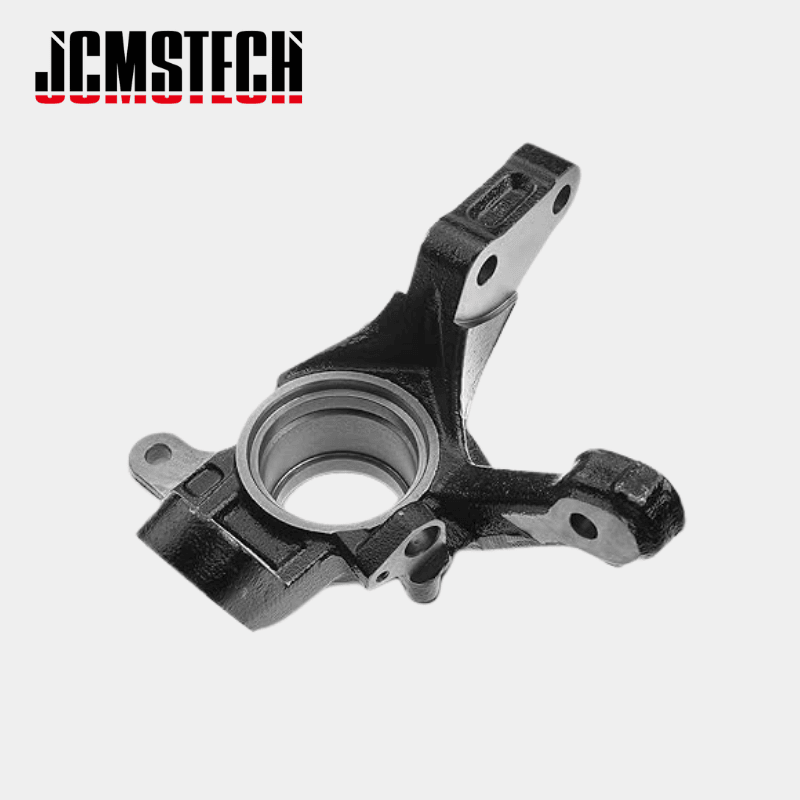
The steering knuckle is a high‑strength metal part installed between the constant‑velocity joint housing and the wheel hub unit. Its high‑strength metal gives it impact resistance, load capacity, and wear resistance. The knuckle is an irregular fork‑shaped part with dedicated holes that connect to the suspension system and the steering system. It allows the wheel to turn left and right while carrying the vehicle’s weight.
What Does a Steering Knuckle Do?
The steering knuckle connects the steering and the suspension. It mainly has three functions.
Load‑bearing and impact resistance
The steering knuckle is a connecting part. It must carry the vehicle’s weight and also bear the impacts from road bumps while the car is moving.
It bears the weight of the front of the vehicle and transmits dynamic forces while driving. This includes vertical load, lateral force during cornering, and impact loads from uneven roads.
Ensure the wheels can turn left and right
The steering knuckle connects to the steering system. When the car needs to change direction, the ball joints control the wheel and change direction through the fixed knuckle.
Provide mounting points
The knuckle looks like an irregular fork, so it has many mounting holes to fix other key connected parts, including the hub bearing, brake caliper, control arm, strut, stabilizer link, and tie‑rod end, ensuring the related systems work closely together.
Where is the Steering Knuckle located in a car?
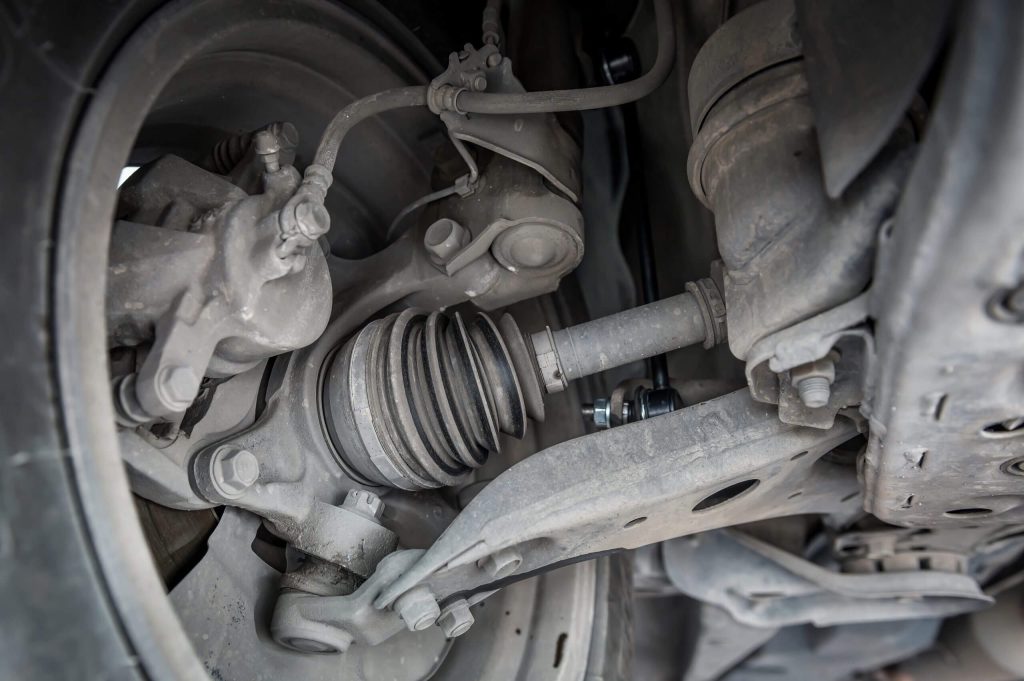
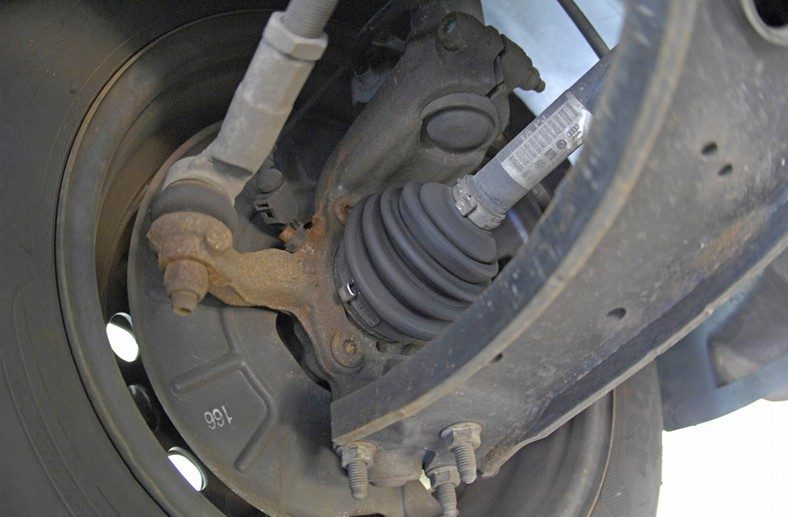
You cannot see the steering knuckle directly from outside the vehicle. The most direct way is to remove the wheel so you can see it clearly. If you look from underneath the car, you will see many parts mounted on one component—this is usually the steering knuckle. Two‑wheel‑drive vehicles have one knuckle on each front side, while four‑wheel‑drive vehicles have four knuckles.
Types of Steering Knuckle
There are many ways to classify steering knuckles. The most common is by structure; they can also be grouped by the suspension they fit or by drive layout. The core differences lie in the connection layout and functional fit. JCMSTECH helps you see how these categories differ.
By Structure
- Fork‑type knuckle: This is the most common structure on the market. It looks like a “Y” or a fork, with holes at the top and bottom for the kingpin/ball‑stud. It fits MacPherson, double‑wishbone, and other suspensions, connects the upper and lower control arms stably, and is widely used on passenger and commercial front axles.
- Hub‑integrated knuckle: The knuckle and the hub‑bearing seat are integrated, which reduces the number of parts. The structure is more compact and rigid. It is often used on high‑end passenger cars or new‑energy vehicles and can improve steering precision and lightweight performance.
- Barrel‑type knuckle: Cylindrical in shape with an extended spindle. It is used on heavy trucks or special vehicles. The barrel design increases torsional strength to handle heavy loads.
By Suspension Type
- MacPherson‑specific knuckle: The structure is relatively simple. The lower side connects to the lower control arm; the upper side is located by the strut. It is small and light and is the mainstream choice for family cars.
- Double‑wishbone‑specific knuckle: Fork interfaces at the top and bottom connect to the upper and lower control arms. Alignment parameters are more stable and steering precision is higher. It is used on mid‑ to high‑end sedans, sports cars, or off‑road models.
- Multi‑link‑specific knuckle: Fits multi‑link front suspensions and works with several links through multiple mounting points. It balances comfort and handling and is common on luxury brands.
By Drive Layout
- Non‑driven‑wheel knuckle: It only undertakes steering and load‑bearing functions and has no power‑transmission structure. It is simple and is used on the front wheels of many two‑wheel‑drive cars (or on the non‑driven axle of four‑wheel‑drive cars).
- Driven‑wheel knuckle: It has a central bore for the half‑shaft, with the hub bearing and the half‑shaft connection integrated inside. It must satisfy steering, load‑bearing, and power transmission at the same time. It is used on the driven wheels of 4WD/AWD vehicles and is more complex.
Other Special Types
- Adjustable knuckle: Used on some modified cars or race cars. By changing the positions of locating holes you can adjust camber, kingpin inclination, and other parameters to optimize handling.
- Lightweight forged knuckle: Made of forged aluminum alloy. It is light and strong, often used on performance cars or new‑energy vehicles to balance handling and driving range.
Can Steering Knuckles Go Bad or Break?
Steering knuckles are known for their durability, but that doesn’t mean they’re immune to failure. The following explains how and why they may eventually go bad.
Here is a lesser‑known fact: the steering knuckle is one of the most durable parts on a car. It is made from very hard metals such as high‑strength steel, aluminum alloy, or ductile iron. But that does not mean it can never fail. In severe impacts or harsh road conditions, it can still be damaged and fracture.
Another common case is corrosion and rust on the knuckle. Although the knuckle itself is very strong, it is fastened to other parts with nuts and bolts. Fractures at these connection points are even more common.
How to Check for a Damaged Steering Knuckle
The steering knuckle can be visually inspected or diagnosed through abnormal driving behavior. Below are several effective methods to check if the knuckle is damaged or deformed.
Direct Inspection
Remove the wheel with proper tools. Carefully check the mounting and connection areas of the knuckle for corrosion, rust, cracks, or deformation. Also check whether the connected parts nearby show grease leakage.
Driving Behavior
If your car behaves abnormally, pay attention—issues with the knuckle should be on your checklist. For example: abnormal steering feel, the car pulling to one side, noises while turning, or abnormalities during braking. In these cases, you need to inspect the steering knuckle.
Shop Inspection
Your car also needs regular maintenance. Many shops will check four‑wheel alignment. If the measured alignment parameters are abnormal, the shop will trace the root cause step by step. If the deviation is large, the steering knuckle is a likely problem. A caliper can also be used to measure whether it is deformed.
Safety Tips
The steering knuckle is a core load‑bearing safety part. If you find cracks, obvious deformation, or alignment parameters that cannot be corrected, it must be replaced immediately—do not repair it and keep driving.
You can combine routine checks with tire rotation and regular service. Pay special attention to vehicles that do long‑term off‑road driving, carry heavy loads frequently, or have had a front‑end collision.
What Are the Symptoms of a Bad Steering Knuckle?
Do not wait until the knuckle fails completely—that is dangerous. Early signs usually appear in steering, straight‑line driving, and braking. You can feel whether there is a problem. The common signs are listed below.
| Symptom | What You Feel or Hear | Possible Cause in the Knuckle |
|---|---|---|
| Heavy steering / sticking | Large resistance at low speed; “notch” feeling while turning | Deformation at the fork area or wear at kingpin/ball-stud mounts |
| Poor steering return to center | Steering doesn’t self-center after a turn | Abnormal caster/camber due to knuckle distortion |
| Increased steering play | Delayed tire response, more empty steering travel | Worn tie-rod or ball-joint holes in the knuckle |
| Vehicle pulls to one side | Car drifts while driving straight | Fork or spindle deformation causing camber offset |
| High-speed vibration | Steering wheel shakes above 80 km/h | Spindle misalignment or brake mount runout |
| Clunking noise | Metal noise when turning or driving over bumps | Loose knuckle, cracks, or worn connection points |
| Brake pull | Car veers during braking | Caliper mount offset due to knuckle deformation |
| Brake pedal pulsation | Pulsing pedal with possible noise | Disc wobble from brake mount irregularities |
| Abnormal tire wear | Sawtooth or one-side wear pattern | Misalignment caused by bent knuckle |
| Wheel bearing failure | Noise or play in short time | Uneven spindle support damaging bearing |
These symptoms often point to alignment or load-bearing issues caused by steering knuckle damage. Early detection helps prevent further suspension or tire damage.
How to Replace a Car’s Steering Knuckle
Replacing a steering knuckle follows similar steps to other parts: prepare tools → remove the bad knuckle → install the new knuckle → do alignment. JCMSTECH interviewed front‑line technicians and summarized the steps below (example: rear knuckle on a passenger car).
Preparation Before Replacement
- Tools: jack, safety stands, socket wrenches, torque wrench, ball‑joint separator, hub‑bearing press (or professional press tools), and a four‑wheel aligner for later calibration.
- Replacement parts: Prepare the new knuckle in advance. If other parts also need replacement, prepare them together. Replacing them at the same time costs less than doing them separately.
Steps to Remove the Bad Knuckle
First remove the rear wheel so that the brake system can be taken off smoothly. Then disconnect the parts that link the steering and suspension one by one. Finally, take out the knuckle. For a hub‑integrated knuckle, use a press to push the bearing out from the spindle area.
Install the New Knuckle
Reverse the removal steps. Install the good knuckle and reconnect everything properly.
Alignment
After installation, perform four‑wheel alignment. If you skip alignment, the replacement is not complete.
Key Torque Reference Table for Steering‑Knuckle Replacement
The following torque values are commonly used during steering knuckle replacement. Always refer to the vehicle’s service manual for exact specifications.
| Fastener | Torque Range (N·m) | Notes |
|---|---|---|
| Hub bearing lock nut | 80–120 | Follow the vehicle manual. After tightening, insert a cotter pin to lock and prevent loosening. |
| Brake caliper mounting bolts | 40–60 | Tighten in two steps. Ensure the caliper sits flush on the knuckle mount with no gaps. |
| Tie‑rod end lock nut | 35–55 | Check steering free play after tightening. Do not overtighten to avoid binding. |
| Upper / lower control‑arm bolts | 60–90 | For double‑wishbone suspensions, tighten the upper and lower arm bolts together. For MacPherson, focus on the lower control arm. |
| Stabilizer link bolt | 25–40 | The bolt has a lock washer. No extra thread adhesive is needed. Tighten to the specified torque. |
| Wheel lug bolts | 100–150 | After the car is back on the ground, tighten in a crisscross order. Do not pre‑torque while the wheel is hanging. |
Note: The above values are general references. Different brands and models (e.g., Japanese / German / domestic) have different torque standards. Always check the vehicle service manual first.
Source: “What are the bolt torque standards for common auto parts?” — Pacific Auto Q&A.
How Long Should a Steering Knuckle Last?
As noted above, the steering knuckle is one of the most durable parts. In general there is no fixed replacement interval unless there is a severe impact. Under normal conditions, a passenger‑car knuckle can last 5–10 years, and sometimes longer. Two scenarios affect the replacement timing:
Ideal Service Life
If you mainly drive on smooth city roads and have good habits, the knuckle may not need replacement until after about 100,000 km. Just maintain the other parts on time so the knuckle is not harmed by issues such as CV joint housing oil leaks or rusted fasteners.
Special‑Case Service Life
Severe impacts, frequent driving on harsh roads, and lack of maintenance on connected parts can all shorten its life.
Conclusion
Every auto part plays an important role, and the steering knuckle is no exception. Its value lies in silently supporting every turn and every trip. We should pay attention to its condition so the car receives proper care and you stay safer on the road.
Frequently Asked Questions (FAQ)
How do I know if my steering knuckle is bad?
Common symptoms of a bad steering knuckle include heavy or uneven steering, poor return to center, unusual tire wear, pulling to one side, clunking noises when turning, or vibration at high speed. A visual inspection may reveal cracks, rust, or deformation. Professional diagnosis may include alignment checks or using a caliper to measure warping.
How much does it cost to replace a steering knuckle?
The average cost to replace a steering knuckle ranges from $250 to $600, including parts and labor. The part itself typically costs $100 to $300 depending on the vehicle make and whether it’s a hub-integrated or forged knuckle. Labor costs vary by region and complexity of the suspension system.
Can you drive with a broken steering knuckle?
No, driving with a broken or cracked steering knuckle is extremely dangerous. It can cause loss of steering control, sudden suspension failure, or uneven braking. If a steering knuckle is damaged, the vehicle should not be driven until the part is inspected and replaced.
What holds the steering knuckle in place?
The steering knuckle is held in place by components such as the control arms (upper and/or lower), ball joints or kingpins, the tie rod end, and the strut or shock absorber. It also interfaces with the hub bearing and spindle, and is secured with bolts and nuts that must be torqued to specification.
How much does a steering knuckle cost?
A replacement steering knuckle typically costs between $100 and $300 for most passenger cars. High-performance or forged aluminum knuckles can cost more. Prices vary based on vehicle type, brand, and whether it’s a front or rear axle part. Always verify part compatibility before purchase.