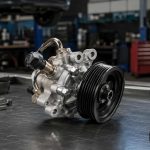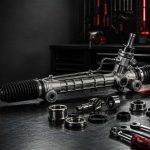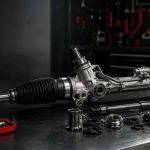
A bad steering rack can cause loose or sloppy steering, stiff or uneven steering effort, clunking or grinding noises, fluid leaks near the rack boots, wandering, pulling, vibration, or a steering wheel that does not return to center. These symptoms can also come from tie rods, ball joints, control arm bushings, tires, wheel alignment, the steering column, or the power steering pump, so do not replace the rack from one symptom alone. Use the checks below to separate a likely steering rack problem from other steering or suspension faults. [S1][S2]
Safety note: Steering components affect vehicle control. If the steering suddenly becomes very hard to turn, feels loose, will not return normally, leaks fluid quickly, or makes heavy clunking with visible play, avoid driving and have the vehicle inspected by a qualified technician.
Quick Answer
A steering rack may be failing when the vehicle has steering play, clunking or grinding during turns, reddish or amber fluid near the rack boots, stiff or notchy steering, wandering, pulling, vibration, or poor return-to-center.
- Fluid near the rack boots often points to a hydraulic rack seal leak rather than a simple reservoir spill.
- Loose steering, wandering, or delayed response may come from the rack, inner tie rods, outer tie rods, bushings, alignment, or tires.
- Whining that changes with engine speed or gets louder while turning is often closer to a power steering pump, fluid, belt, or hose problem than a rack-only failure.
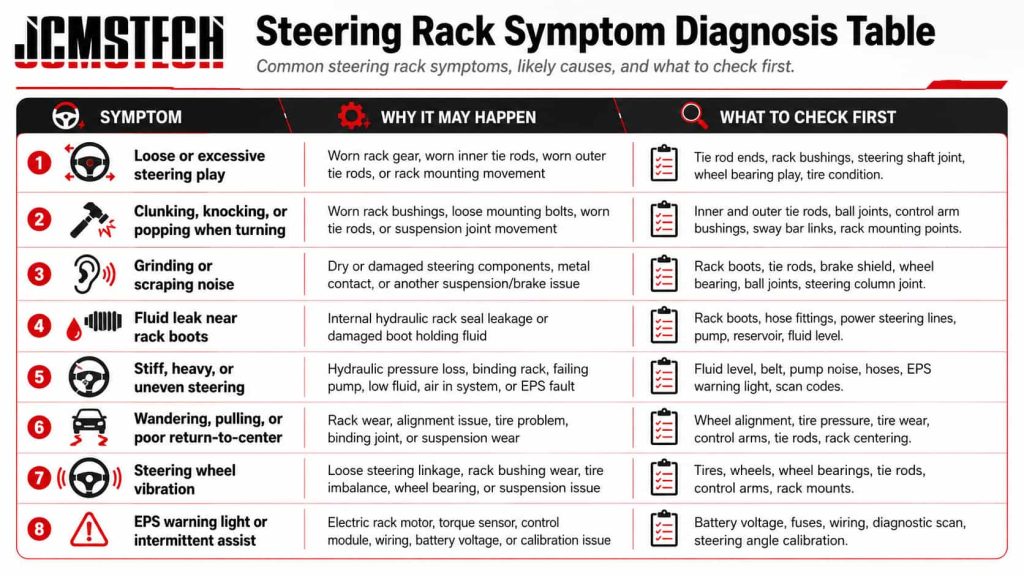
Steering Rack Symptom Diagnosis Table
| Symptom | Why it may happen | What to check first |
|---|---|---|
| Loose or excessive steering play | Worn rack gear, worn inner tie rods, worn outer tie rods, or rack mounting movement | Tie rod ends, rack bushings, steering shaft joint, wheel bearing play, tire condition |
| Clunking, knocking, or popping when turning | Worn rack bushings, loose mounting bolts, worn tie rods, or suspension joint movement | Inner and outer tie rods, ball joints, control arm bushings, sway bar links, rack mounting points |
| Grinding or scraping noise | Dry or damaged steering components, metal contact, or another suspension/brake issue | Rack boots, tie rods, brake shield, wheel bearing, ball joints, steering column joint |
| Fluid leak near rack boots | Internal hydraulic rack seal leakage or damaged boot holding fluid | Rack boots, hose fittings, power steering lines, pump, reservoir, fluid level |
| Stiff, heavy, or uneven steering | Hydraulic pressure loss, binding rack, failing pump, low fluid, air in system, or EPS fault | Fluid level, belt, pump noise, hoses, EPS warning light, scan codes |
| Wandering, pulling, or poor return-to-center | Rack wear, alignment issue, tire problem, binding joint, or suspension wear | Wheel alignment, tire pressure, tire wear, control arms, tie rods, rack centering |
| Steering wheel vibration | Loose steering linkage, rack bushing wear, tire imbalance, wheel bearing, or suspension issue | Tires, wheels, wheel bearings, tie rods, control arms, rack mounts |
| EPS warning light or intermittent assist | Electric rack motor, torque sensor, control module, wiring, battery voltage, or calibration issue | Battery voltage, fuses, wiring, diagnostic scan, steering angle calibration |
Top Signs of a Bad Steering Rack
1. Loose or sloppy steering
Loose steering is one of the most common warning signs. The steering wheel may move more than normal before the front wheels respond, or the vehicle may feel vague at highway speed. In some cases, the driver has to make constant small corrections to keep the car straight. [S1][S2]
This symptom does not automatically prove the rack is bad. Inner tie rods, outer tie rods, rack bushings, control arm bushings, wheel bearings, tires, or alignment can create a similar loose feeling. If the steering wheel has sudden play or the vehicle feels difficult to control, avoid normal driving until the system is inspected.
2. Clunking, knocking, or popping when turning
A worn rack, loose rack mounts, worn tie rods, or damaged suspension joints can produce clunking or knocking noises during low-speed turns, parking maneuvers, or driving over bumps. A rack-related noise often feels connected to steering input, while a suspension noise may be stronger over bumps even when the wheel is not turning. [S1][S5]
Check the rack mounting points, inner and outer tie rods, ball joints, control arm bushings, sway bar links, and steering shaft joint before blaming the rack itself.
3. Fluid leaks near the rack boots
On hydraulic rack-and-pinion systems, reddish, amber, or brown fluid around the rack boots is a strong warning sign. Rack boots are designed to protect the inner tie rods and rack ends; they are not meant to hold power steering fluid. If a boot is wet inside or dripping, the internal rack seals may be leaking. [S1][S2]
A leak near the pump, reservoir, or hoses may not mean the rack is bad. First identify where the fluid begins, clean the area if needed, top up with the correct fluid, and recheck after a short inspection period. Do not ignore a fast leak, because low fluid can increase steering effort and may damage the power steering pump.
4. Stiff, heavy, or uneven steering
A bad steering rack can bind internally and make the wheel feel heavy, notchy, or inconsistent. However, heavy steering can also come from low fluid, air in the system, a weak pump, a slipping belt, damaged hoses, seized joints, low tire pressure, or an electric power steering fault.
If the steering is heavy only at idle or during parking, check the pump, belt, fluid level, and fluid condition. If the steering feels tight in one section of the wheel’s travel, the rack or steering column joint may need closer inspection. [S2][S6]
5. Wandering, pulling, or poor return-to-center
A worn or binding rack can make the vehicle drift, wander, or fail to return smoothly after a turn. It may feel like the car does not want to track straight even after small steering corrections.
This symptom overlaps with alignment, tire wear, tire pressure, control arm bushings, tie rods, ball joints, and brake drag. If the vehicle pulls sharply, the steering wheel is off-center, or the car changes direction unexpectedly, inspect the full steering and suspension system before replacing the rack.
6. Steering wheel vibration or shimmy
Steering wheel vibration can come from rack bushings, loose linkage, tie rods, wheel imbalance, tire defects, wheel bearings, brake components, or suspension wear. A rack-related vibration often appears together with play, clunking, or uneven steering response.
Do not diagnose a rack only because the steering wheel shakes. Check tires, wheels, wheel bearings, brake rotors, tie rods, control arms, and alignment first.
7. Burning smell or overheated power steering fluid
Low fluid, aerated fluid, a failing pump, a restricted line, or a leaking hydraulic rack can overheat the power steering system. A burning smell near the engine bay or dark, foamy fluid means the system should be inspected before more parts are damaged.
If the rack is leaking internally, the pump may work harder to maintain pressure. If the pump is failing, it can also make the steering heavy even when the rack is not the root cause. This is why leak location and pump noise matter.
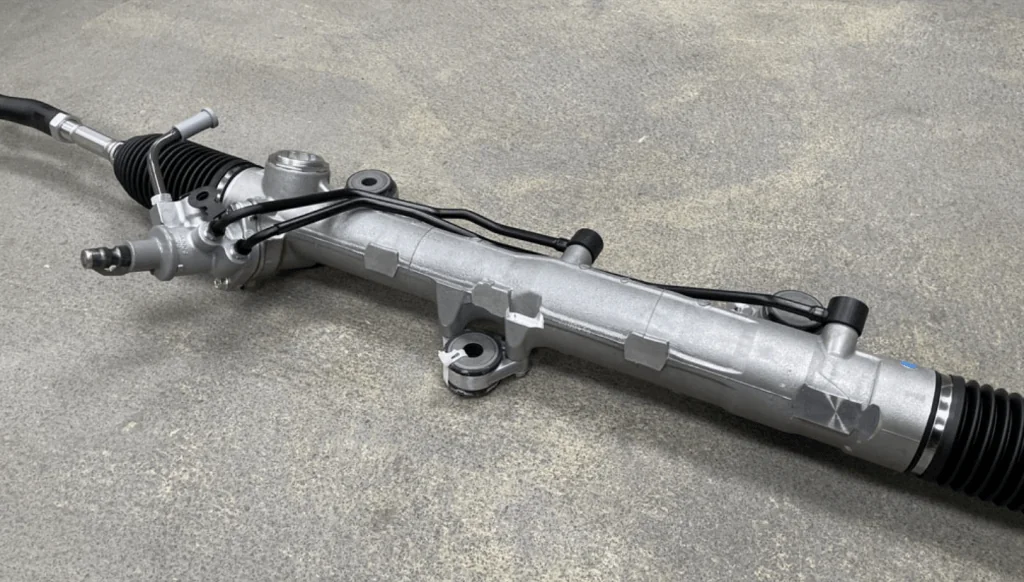
Power Steering Pump vs Steering Rack Symptoms
A steering rack and a power steering pump can create overlapping symptoms, especially on hydraulic systems. Use this table to narrow the likely source before ordering parts.
| Symptom | More likely steering rack | More likely power steering pump, fluid, or hose |
|---|---|---|
| Steering feels loose or has play | Yes, especially with tie rod or rack bushing movement | Less common |
| Clunking when turning or over bumps | Possible, especially with rack mounts or inner tie rods | Usually not the main cause |
| Fluid inside rack boots | Strong rack warning sign | Pump may be affected later by low fluid |
| Whining or groaning noise | Possible but less specific | Common, especially when the noise changes with engine speed or steering load |
| Heavy steering at low speed | Possible if rack binds | Common with low fluid, air in system, weak pump, belt slip, or hose restriction |
| Foamy fluid in reservoir | Usually not the first cause | Often linked to air in the system, low fluid, suction leak, or pump issue |
| EPS warning light | Possible on electric steering racks | Not related to a hydraulic pump; scan the EPS system |
If the main symptom is a whining or groaning sound, compare it with the power steering pump guides before replacing a rack. If the main symptom is steering play, rack boot leakage, or delayed wheel response, inspect the rack, tie rods, and mounting points first. [S6][S7]
Symptoms That May Not Be the Steering Rack
Many steering symptoms can come from nearby parts. Replacing the rack without checking these items can lead to unnecessary cost and an unchanged problem.
| Possible source | Similar symptom | What to inspect |
|---|---|---|
| Outer tie rod end | Loose steering, clunking, uneven tire wear | Ball joint at the tie rod end, torn boot, looseness when moving the wheel side to side |
| Inner tie rod | Steering play, knocking, vague response | Inner joint under rack boot, axial play, torn rack boot |
| Ball joint | Clunking, wandering, uneven tire wear | Vertical or lateral wheel play, damaged boot, control arm movement |
| Control arm bushing | Pulling, wandering, clunking over bumps | Cracked bushings, shifting arm position, uneven tire wear |
| Wheel bearing | Vibration, humming, wheel play | Bearing noise, hub play, heat, ABS sensor issues |
| Tires or alignment | Pulling, off-center steering wheel, uneven wear | Tire pressure, tread wear, alignment readings |
| Steering column joint | Binding, clicking, uneven steering feel | U-joint stiffness, corrosion, looseness, steering shaft play |
| Power steering pump or belt | Whining, heavy steering, foamy fluid | Fluid level, belt condition, pump noise, suction hose, reservoir |

Can You Drive With a Bad Steering Rack?
You should not continue normal driving if the steering rack problem causes heavy steering, excessive play, rapid fluid loss, clunking with visible movement, or unstable vehicle tracking. A steering rack is part of the system that lets you control the front wheels, so a serious rack fault can become dangerous quickly.
For mild symptoms, a short and careful drive to a repair shop may be possible, but avoid high speed, heavy traffic, towing, or long-distance driving. If the steering suddenly becomes hard to turn or the vehicle does not respond predictably, stop driving and arrange inspection or towing. [S1][S2]
What to Check Before Replacing the Steering Rack
- Check the fluid level and condition. Low, foamy, dark, or burnt-smelling fluid may point to leaks, air in the system, pump trouble, or overdue service.
- Find the leak source. Clean the area if needed, then check whether fluid starts at the pump, reservoir, hoses, fittings, or rack boots.
- Inspect both rack boots. A wet boot can indicate internal seal leakage on a hydraulic rack.
- Check inner and outer tie rods. With the front wheels safely lifted, look for play, torn boots, or loose joints.
- Look at rack mounting points. Loose or worn bushings can cause clunks, vibration, and steering movement.
- Check related suspension parts. Ball joints, control arms, sway bar links, struts, tires, and wheel bearings can mimic rack symptoms.
- Scan electric steering systems. EPS faults may involve sensors, wiring, voltage, calibration, or a control module, not only the rack assembly.
- Confirm alignment and steering center. Poor alignment or an off-center wheel can feel like rack trouble even when the rack is not the root cause.
If the inspection points to a failed rack, confirm the correct replacement part before ordering. Steering rack fitment can vary by vehicle year, drivetrain, steering type, left-hand or right-hand drive, sensor configuration, and included components.
What to Confirm Before Ordering a Steering Rack
- Vehicle year, make, model, trim, engine, and drivetrain
- VIN or OE number, if available
- Hydraulic, electric, or electro-hydraulic steering system
- Left-hand drive or right-hand drive
- Rack length, input shaft type, mounting points, and line fittings
- Whether inner tie rods, boots, bushings, sensors, motor, or control module are included
- New, remanufactured, or used condition
- Core return requirement, warranty terms, and packaging
- Whether alignment, bleeding, steering angle calibration, or EPS programming is needed after installation
Do not assume two racks are interchangeable only because they look similar in a photo. Confirm OE number, vehicle configuration, and included components before ordering.
When Replacement Usually Makes Sense
Replacement is more likely when the rack has internal seal leakage, excessive play inside the rack, damaged gear teeth, a binding section in the steering travel, worn internal bushings, or a failed electric rack motor/module that is not serviceable separately.
Repair may be possible in some cases, such as replacing outer tie rods, boots, hoses, fluid, or mounting bushings. However, many modern rack assemblies are replaced as a unit when internal wear, leakage, or EPS failure is confirmed. [S4][S5]
Related Guides
- Steering Rack Replacement Cost — Use this when the rack is already suspected or confirmed and you need parts, labor, alignment, and regional cost ranges.
- How to Replace a Steering Rack — Use this for a safety-first overview of removal, rack centering, installation, bleeding, and alignment.
- Power Steering Pump vs Steering Rack — Use this when symptoms overlap and you need to separate pump, rack, hose, and fluid problems.
- How to Know If a Power Steering Pump Is Bad — Use this when whining, groaning, foamy fluid, or heavy low-speed steering is the main symptom.
- Power Steering Pump Noise — Use this if the main complaint is a whining, squealing, groaning, or cold-start noise.
Frequently Asked Questions
How do I know if my steering rack is bad?
A steering rack may be bad if you notice steering play, clunking or grinding when turning, fluid leaking from the rack boots, stiff or uneven steering, wandering, pulling, vibration, or poor return-to-center. The best confirmation comes from checking leak location, tie rod play, rack mounting movement, related suspension parts, and EPS fault codes if the vehicle uses electric steering. [S1][S2]
What does a failing steering rack feel like?
It may feel loose, vague, heavy, notchy, or inconsistent. The steering wheel may require extra correction on the highway, fail to return smoothly after a turn, or feel delayed before the front wheels react.
Can a bad steering rack make noise?
Yes. A failing rack, worn rack bushings, loose mounting points, or worn inner tie rods can cause clunking, knocking, popping, or grinding noises. Similar noises can also come from ball joints, control arm bushings, sway bar links, wheel bearings, or the steering column joint.
Can a power steering pump be mistaken for a bad steering rack?
Yes. A weak pump, low fluid, air in the system, a slipping belt, or a blocked hose can make the steering heavy or noisy. Pump problems often create a whining or groaning noise that changes with engine speed or steering load, while rack problems more often show up as play, boot leaks, clunking, binding, or poor steering response. [S6][S7]
Is a steering rack the same as rack and pinion?
In many passenger vehicles, “steering rack” refers to the rack-and-pinion steering assembly. Some vehicles may use different steering gear designs, so confirm the system type before ordering parts.
Can I drive with a bad steering rack?
Do not continue normal driving if the steering feels loose, suddenly becomes very hard to turn, leaks fluid quickly, clunks with visible play, or causes unstable handling. A mild symptom may allow a careful short trip to a repair shop, but a serious steering fault should be inspected before further driving.
Does replacing a steering rack require alignment?
Usually yes. Steering rack replacement commonly affects tie rod position and steering geometry, so a professional wheel alignment is normally required afterward. Some electric systems may also need steering angle calibration or scan-tool procedures. [S4][S5]
How long does a steering rack last?
There is no single mileage that applies to every vehicle. Service life depends on road conditions, fluid condition, steering system design, seal condition, driving habits, corrosion, and whether related parts are worn. Focus on symptoms and inspection results rather than mileage alone.
What causes a steering rack to fail?
Common causes include worn internal seals, contaminated or low power steering fluid, torn rack boots, corrosion, impact damage, worn bushings, damaged gear teeth, overloaded steering components, or electrical failure in EPS racks.
Should I replace the pump and rack together?
Not automatically. Replace the confirmed failed part. However, if a hydraulic rack has been leaking for a long time, the pump may have been run low on fluid and should be inspected. If the pump failed and contaminated the system, the rack, hoses, and fluid may also need checking.
Sources
[S1] AutoZone — Signs of a Failing Rack and Pinion; rack and pinion replacement cost overview. Used for common symptoms, safety context, and inspection direction.
[S2] NAPA Know How — Symptoms of a Failing Rack and Pinion. Used for steering effort, movement, leaks, and wandering context.
[S3] CarParts.com — Steering rack and steering rack bushing guides. Used for related symptoms such as play, vibration, clicking, and bushing-related issues.
[S4] RepairPal — Rack and Pinion Replacement Cost Estimate. Used for cost context and related-repair caution.
[S5] JCMSTECH — How to Replace a Steering Rack. Used for replacement workflow, centering, bleeding, alignment, and safety reminders.
[S6] JCMSTECH — Power Steering Pump vs Steering Rack. Used for symptom separation between pump, rack, fluid, and hose problems.
[S7] JCMSTECH — Power Steering Pump Noise. Used for whining, groaning, low-fluid, and pump-related symptom comparison.
[S8] JCMSTECH — How to Flush and Bleed a Power Steering System. Used for air-in-system and post-service fluid checks.
Disclosure: This article is educational and does not replace a vehicle-specific inspection, factory service procedure, or qualified technician’s diagnosis. Steering and suspension systems are safety-critical. If you are unsure about the cause of a steering problem, have the vehicle inspected before driving.